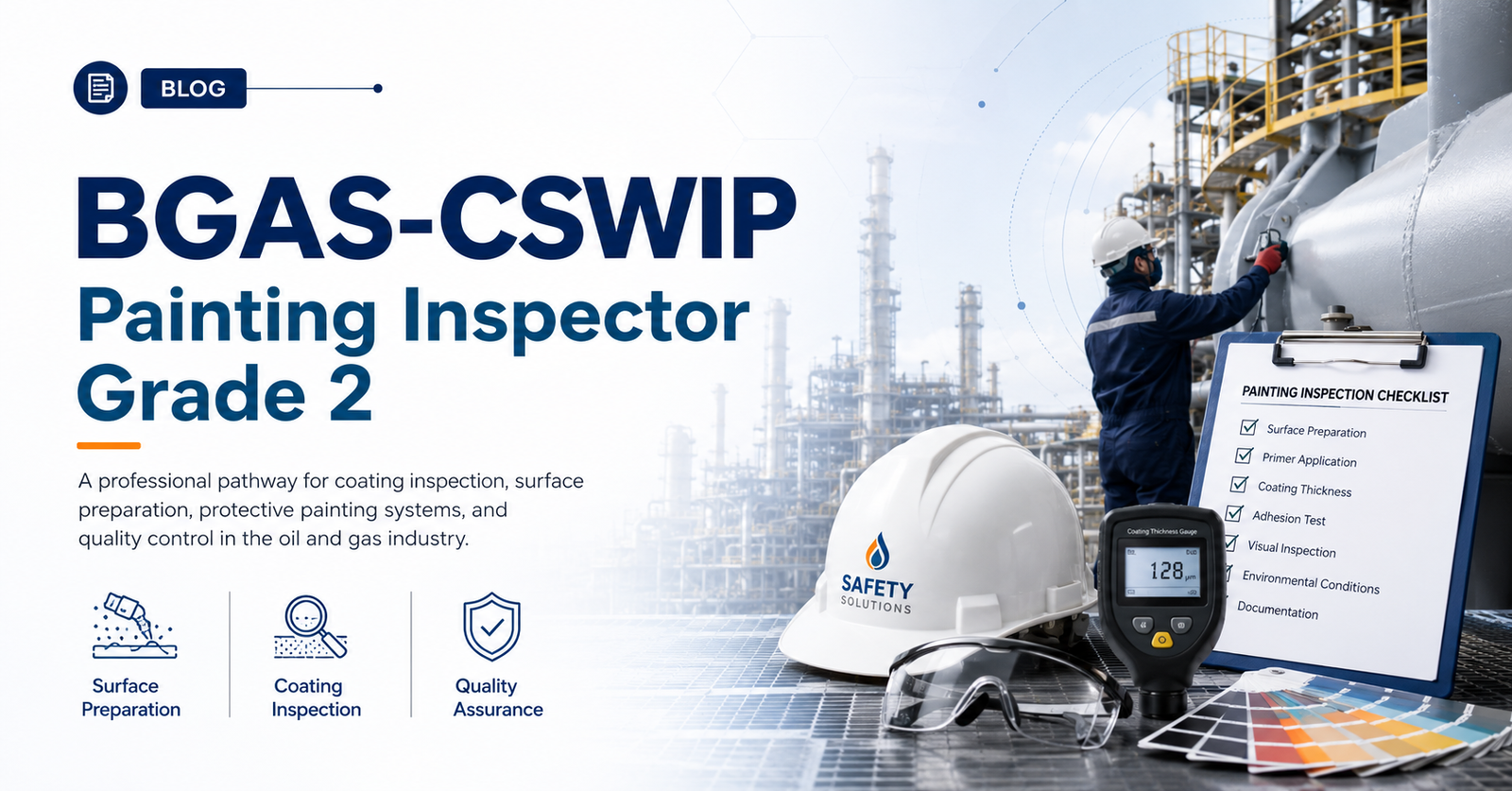
BGAS-CSWIP is a TWI-accredited coating inspection qualification that certifies people to inspect surface preparation and industrial coatings on oil, gas, pipeline, and refinery projects. Grade 2 (Painting Inspector) is the entry-level working role—the one job postings refer to when they say “BGAS certified.”
If you’re entering coating inspection or QA/QC roles in the Gulf, this credential opens specific doors. If you’re not sure whether you need it, read on.
What Is BGAS-CSWIP? (Definition & Industry Relevance)
BGAS-CSWIP is a certification scheme developed and run by TWI (The Welding Institute) in the United Kingdom. It certifies inspectors who assess surface preparation and industrial coating work on large infrastructure projects—oil and gas, pipelines, fabrication yards, refineries, and offshore installations.
The credential is accredited by UKAS (United Kingdom Accreditation Service) to ISO/IEC 17024, which means it’s internationally recognized. On Gulf projects, that matters: a UKAS-accredited certificate travels across borders without employers questioning its validity.
Why employers ask for it by name:
- Coating failures are expensive. A single breach in protective coating can lead to corrosion, pipe leaks, and tens of thousands in emergency repairs.
- The person inspecting that coating needs to know corrosion theory, surface quality standards, and paint science—not just visual checks.
- BGAS-CSWIP certifies exactly that knowledge.
What Does the BGAS-CSWIP Course Actually Cover?
The course is heavier on science than most job seekers expect. You’re not learning to spot bad paint jobs by eye. You’re learning why coatings fail and how to prevent it.
Core Topics Covered:
Corrosion Theory & Prevention
- How steel oxidizes and degrades
- Cathodic protection principles
- Corrosion mechanisms in offshore and pipeline environments
Surface Preparation Standards
- Steel blast cleaning grades (ISO 8501, ASTM D6386)
- Surface profile measurement and acceptance criteria
- Contamination detection (salt spray tests, conductivity testing)
- Why improper surface prep is the #1 reason coatings fail
Paint Science & Coating Technology
- Paint constituents: binders, pigments, solvents, additives
- Coating types: epoxy, polyurethane, polyester, zinc-rich primers
- Film thickness measurement and dry matter content
- Cure times, pot life, and application conditions
Inspection & Testing Methods
- Holiday detection (electrical continuity testing)
- Adhesion testing and pull-off testing
- Coating thickness measurement (electromagnetic gauges)
- Documentation and reporting standards
Practical Application
- How to walk up to a blasted steel surface in real conditions
- Decide whether it’s fit for coating or needs rework
- When environmental conditions stop work (humidity, temperature, dew point)
- Writing inspection reports that meet contract specifications
By completion, you can independently assess surface quality and decide whether work meets specification or must be redone—a decision that often stops or delays multi-million dollar projects, which is why someone with this knowledge is valuable.
BGAS-CSWIP Grade Levels: Which One Do You Need?
BGAS is not a single exam. There are four certification levels:
| Grade | Role | Level | Typical Job |
|---|---|---|---|
| Grade 2 | Painting Inspector | Entry/Working Level | Daily site inspections, surface assessment, test documentation |
| Grade 1 | Painting Inspector | Senior/Supervisory | Technical support to engineers, defect troubleshooting, spec interpretation |
| Grade 4 | Painting Supervisor | Blasting & Application | Supervises blasting and coating application crews |
| Operative | Blasting/Application Operative | Entry | Crew member on blasting or application teams |
If a job posting just says “BGAS certified,” it means Grade 2 Painting Inspector. Start there. Grade 1 comes after you have field experience and want to move into a more technical/supervisory role.
Who Should Actually Get BGAS-CSWIP?
This certification is for you if:
- You’re entering coating or painting inspection roles on oil, gas, pipeline, or refinery projects
- You’re transitioning into QA/QC positions in fabrication yards or offshore work
- You already have an inspection background (welding, mechanical, general QA) and want to specialize in coatings—a higher-paying niche
- You’re targeting Gulf employment where the credential is actively requested
This is NOT the right choice if:
- You want a “general” inspection credential to add to your CV
- You’re not actually interested in coating/corrosion work
- You’re looking for a safety certification (this is not OSHA or safety-focused)
- You need welding inspection or structural inspection credentials instead
One critical point: BGAS-CSWIP is a coating inspection qualification. It does not replace welding inspection (AWS, CSWIP), safety credentials (IOSH, OSHA), or ISO auditing qualifications. It pairs well with those credentials, but pick BGAS because you want the coatings career path, not because it sounds impressive on a resume.
BGAS-CSWIP vs. Other Inspection Certifications: Which One Fits?
Many people confuse BGAS-CSWIP with other inspection credentials. Here’s the breakdown:
| Certification | Focus | Best For | Market Demand (Gulf) |
|---|---|---|---|
| BGAS-CSWIP | Coatings & surface preparation | Painting/coating inspectors | High (specialized niche) |
| AWS/CSWIP Welding Inspection | Weld quality & integrity | Welding inspectors | Very High (broad market) |
| IOSH/OSHA | Workplace safety | Safety officers, site supervisors | High (regulatory) |
| ISO/IEC 17020 | General inspection body accreditation | Inspection companies | Medium (organizational level) |
BGAS-CSWIP is the most specific—which makes it valuable in the niche (high pay, steady work) but narrower in job market reach than, say, welding inspection.
Is BGAS-CSWIP Worth the Money? (Honest Assessment)
Short answer: Yes, but only if you’re committed to coatings work.
When It’s Worth It:
- Coating inspectors are in steady, recognized demand across Gulf oil & gas projects
- The credential is what gets your CV past the first filter on high-paying positions
- Once certified, you have a specific, defensible skill that fewer people possess (niche command higher rates)
- Employers actively list BGAS-CSWIP as a requirement, not a “nice-to-have”
- Job security: coatings work exists across economic cycles (maintenance, inspection, QA are ongoing)
When It’s NOT Worth It:
- If you’re undecided about your career direction, this is an expensive test of commitment
- If you want a “general” credential to boost your CV, invest elsewhere
- If coating/corrosion work doesn’t interest you, the cost isn’t justified
- If you’re exploring options, start with a narrower, cheaper foundational course first
Cost consideration: BGAS-CSWIP Grade 2 training and examination typically runs 800–1500 USD depending on provider. That’s significant. If you’re uncertain, don’t guess.
How to Know If BGAS-CSWIP Is the Right Move for Your Career
Ask yourself these questions:
- Do you already have inspection or QA/QC experience? If yes, BGAS-CSWIP is a clear specialization. If no, you might need general inspection foundation first.
- Are you targeting Gulf employment specifically? If yes, this credential will be directly useful. If you’re looking at domestic markets, demand varies by country.
- Can you commit to coating/corrosion work for the next 3–5 years? Career changes are fine, but this credential pays off when you’re in the market it’s designed for.
- Do you have the technical foundation? Basic science knowledge (chemistry, materials) helps significantly. If that’s weak, budget extra time.
BGAS-CSWIP Training & Examination: What to Expect
Course Duration: Typically 5–7 days intensive or 3–4 weeks part-time
Examination Format:
- Written exam: 100 multiple choice questions (2 hours)
- Pass mark: 70%
- Practical assessment may be required depending on provider
After Passing:
- UKAS certificate issued (valid for 3 years)
- Renewal requires continuing professional development (CPD)
- Recertification every 3 years with CPD evidence
Study Tips:
- Focus on surface preparation standards (ISO 8501, ASTM D6386)—these come up repeatedly
- Learn surface profile measurement (Ry, Ra values)
- Understand dew point and environmental conditions for coating application
- Familiarize yourself with inspection tool types and their accuracy ranges
BGAS-CSWIP in the Gulf Job Market: Demand & Salary Reality
Job Market Demand: High in specialized sectors
- Actively requested on oil & gas, pipeline, and refinery projects
- Strong demand in UAE, Saudi Arabia, Qatar (major project hubs)
- Less common in smaller or purely domestic projects
Salary Context (Gulf Market):
- Entry Level (Grade 2, no experience): 2,500–4,000 USD/month
- With 2+ years coating inspection experience: 4,500–7,000 USD/month
- Senior (Grade 1 + experience): 7,000–10,000+ USD/month
(Figures are approximate and vary by country, company, and project scope. Always verify current rates with recruiters in your target market.)
Employment Path: Most BGAS-CSWIP holders in the Gulf work through:
- Direct hire by oil & gas operators (Aramco, ADNOC, etc.)
- Contractor/subcontractor roles on major projects
- Inspection firms supporting EPC contracts
- Inspection companies (certification firms)
Frequently Asked Questions About BGAS-CSWIP
Q: Can I get BGAS-CSWIP without prior inspection experience?
A: Yes, but you should have some technical background (engineering, materials science, or general QA/QC). If you’re completely new to inspection, consider a foundational QA/QC course first. Providers can advise on prerequisites.
Q: How long does the certificate last?
A: 3 years. To renew, you need Continuing Professional Development (CPD) hours and evidence of active practice in coating inspection. Recertification involves an exam or evidence-based renewal.
Q: Will BGAS-CSWIP alone get me a job?
A: The credential opens doors, but employers also want practical experience. Most entry-level positions ask for BGAS-CSWIP + 2–3 years of hands-on coating inspection or QA/QC work. Start building field experience while pursuing certification.
Q: Is BGAS-CSWIP recognized outside the Gulf?
A: Yes, it’s UKAS-accredited to ISO/IEC 17024, which means international recognition. However, market demand varies. In the UK, USA, and some other regions, it’s less commonly requested than in the Gulf.
Q: Should I do BGAS-CSWIP or AWS welding inspection first?
A: Different paths. Welding inspection (AWS) is broader market demand but doesn’t cover coatings. BGAS-CSWIP is specialized. Choose based on your target role. If you’re unsure, AWS is the safer bet (wider job market).
Q: Can I do Grade 1 directly without Grade 2?
A: Typically no. Most training providers require Grade 2 first. Grade 1 assumes you have field experience and are ready for supervisory/technical roles.
How to Choose a BGAS-CSWIP Training Provider
Not all training is equal. When choosing a provider:
Verify These Points:
- Is the provider TWI-approved or officially recognized? (Check TWI’s provider list)
- Are instructors actively certified and practicing in coating inspection? (Not just trainers)
- Do they include practical assessments, not just theory?
- What’s their pass rate? (High pass rates can indicate easier standards; research reviews)
- Do they offer job placement or employer connections post-course?
Red Flags:
- “100% pass rate” claims (unrealistic)
- No practical assessment component
- Extremely low cost (often indicates poor quality)
- Instructors with no active field experience
The Real Bottom Line: Is BGAS-CSWIP Right for You?
Get BGAS-CSWIP if:
- You’re serious about coating inspection or corrosion protection work
- You’re targeting Gulf employment (where it’s actively requested)
- You can commit 3–5 years to this career path
- You have technical foundation or willingness to build it
Skip BGAS-CSWIP if:
- You’re undecided about your direction
- You want a “general” inspection credential
- Your target market doesn’t specifically request it
- You’re looking for a quick CV boost
Need clarity on whether BGAS-CSWIP fits your specific background and the Gulf market?
We assess candidates constantly. Message Chemineer Management on WhatsApp at +92 313 9536365. We’ll tell you honestly which certification path matches your experience, your target role, and what Gulf employers are actually hiring for right now—not what sounds good in theory.