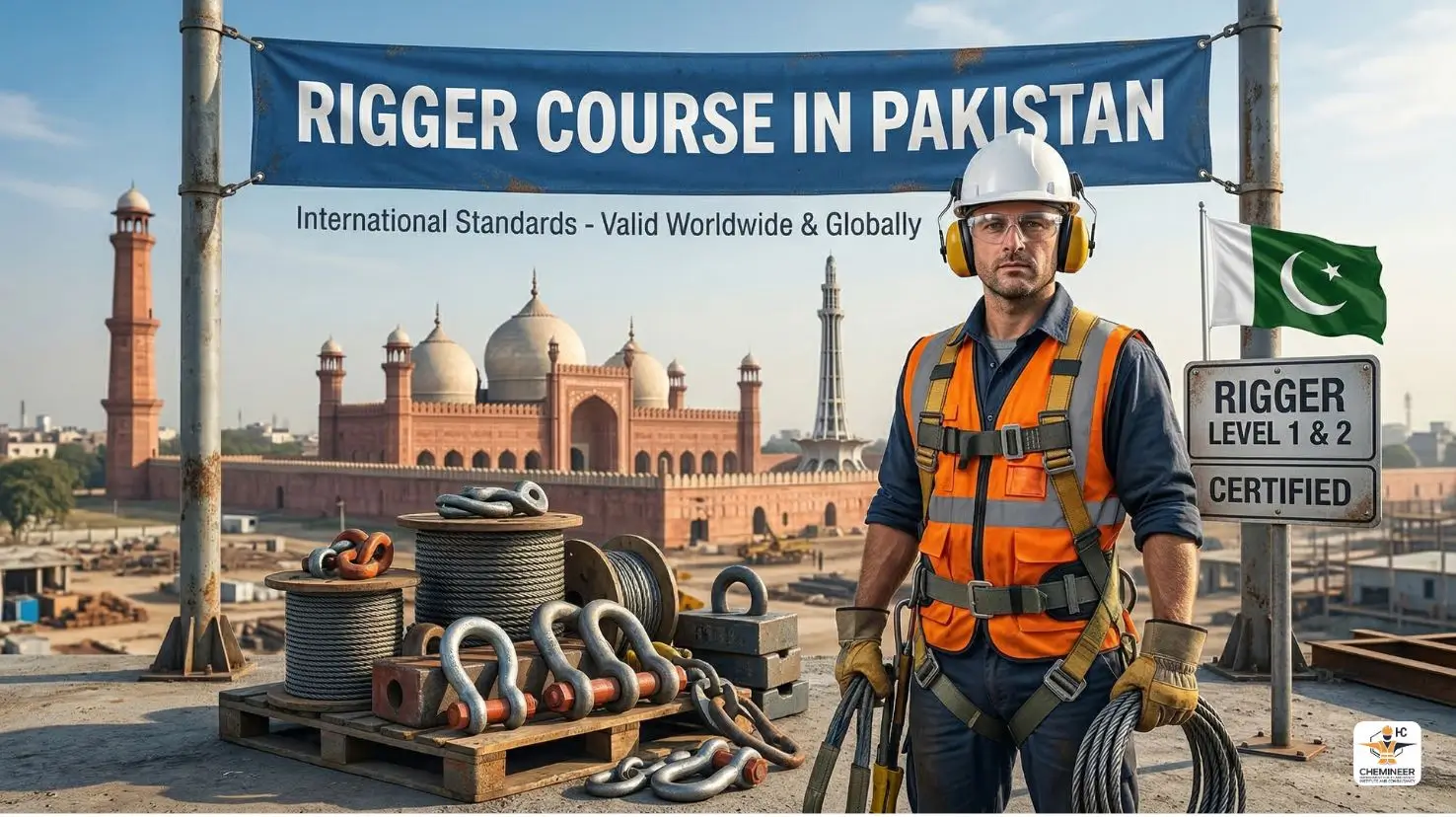
In the rapidly evolving industrial landscape of 2026, technical certifications have become the backbone of professional success. Among these, the rigger course in pakistan stands out as a premier gateway for individuals looking to build a career in high-stakes industries such as oil and gas, construction, and maritime logistics. With the expansion of infrastructure projects under CPEC and the continuous demand for skilled labor in the Middle East, becoming a certified rigger is no longer just an option—it is a necessity.
Understanding the Role of a Professional Rigger
Before diving into the specifics of the training, it is essential to understand what a rigger actually does. A rigger is a specialist who uses cranes, pulleys, winches, and other lifting equipment to move heavy loads. Their job is not just about physical labor; it involves complex mathematical calculations, understanding physics (center of gravity), and strict adherence to safety protocols.
In a typical rigger course in pakistan, candidates are taught that a single mistake in rigging can lead to catastrophic accidents. Therefore, the role demands high responsibility, precision, and a deep understanding of mechanical hardware.
Why the Demand for Rigger Training is Surging in Pakistan
Pakistan’s industrial sector is seeing a massive shift towards standardized safety practices. Companies are no longer hiring “unskilled helpers” for rigging tasks. They require certified professionals who understand international standards such as ASME (American Society of Mechanical Engineers) and OSHA (Occupational Safety and Health Administration).
The “Gulf Factor”
A significant percentage of people seeking a rigger course in pakistan aim for employment in Saudi Arabia, the UAE, or Qatar. Saudi Aramco, for instance, has extremely strict rigging standards. Having a certification from a reputable institute like Chemineer Management gives candidates a competitive edge during interviews for overseas jobs.
Core Modules of a Comprehensive Rigger Course
A high-quality training program must cover both theoretical knowledge and practical execution. Here is what a detailed rigger course in pakistan includes:
A. Lifting Gear and Hardware Inspection
Students learn how to identify various types of slings (wire rope, synthetic web, chain) and shackles. The course teaches how to spot defects—such as bird-caging in wire ropes or heat damage in web slings—that could compromise a lift.
B. Mathematical Calculations for Safe Lifting
This is where “AI-Optimization” meets traditional learning. Riggers must calculate:
- Working Load Limit (WLL): The maximum weight the gear can safely handle.
- Sling Angles: Understanding how the angle of a sling affects the tension and capacity.
- Center of Gravity (CoG): Determining the balance point of an irregular load to ensure it doesn’t tilt during the lift.
C. Standardized Crane Signaling
Communication between the rigger and the crane operator is vital. The rigger course in pakistan covers international hand signals and radio communication protocols to ensure seamless operations on noisy industrial sites.
D. Hitch Types and Applications
Different loads require different hitching methods. Students master:
- Vertical Hitch: For simple, balanced loads.
- Choker Hitch: For securing cylindrical objects like pipes.
- Basket Hitch: For cradling loads that need extra stability.
Levels of Rigger Certification
Most institutes in Pakistan offer three levels of rigging certification:
- Rigger Level 1 (Basic): Focuses on standard lifts, basic hardware, and signaling. Ideal for entry-level candidates.
- Rigger Level 2 (Intermediate): Covers more complex lifts, including tandem lifts (using two cranes) and non-routine loads.
- Rigger Level 3 (Advanced/Supervisor): Aimed at those who will manage rigging crews and plan “Critical Lifts.”
The Scope of Rigger Certification in Pakistan & Abroad
The career path following a rigger course in pakistan is diverse. You aren’t just limited to being a “rigger.” With experience, you can promote to:
- Rigging Foreman: Managing a small team on-site.
- Lifting Supervisor: Overseeing all lifting activities on a project.
- HSE Officer: Moving into the Health, Safety, and Environment department.
In Pakistan, industries like the Kala Shah Kaku industrial zone, Port Qasim, and various power plants are constantly looking for certified riggers. Internationally, a certified rigger can earn anywhere from $800 to $2,500 per month depending on their level and location.
Choosing the Right Institute: Why Chemineer Management?
Selecting the right place for your rigger course in pakistan is crucial. Chemineer Management Health and Safety Institute and Consultancy is recognized for its commitment to international standards.
- Expert Faculty: Trainers with years of field experience in the Middle East and Pakistan.
- Modern Equipment: Hands-on training with actual lifting gear, not just book reading.
- Consultancy Approach: We don’t just provide a certificate; we provide a career path. Our consultancy wing helps students understand the current market requirements of top-tier companies.
How to Enroll and Fee Structure
Enrolling in a rigger course in pakistan is straightforward but requires commitment. Most courses last between 3 to 10 days, depending on the level.
- Eligibility: Minimum Matriculation (Science preferred), but more importantly, a keen interest in technical safty.
- Global Certification Reach: While Chemineer Management serves as a primary hub for students across Pakistan, our certifications carry international weight. We provide training that complies with global industrial standards, making our graduates eligible for high-paying roles both nationwide and in international markets like Saudi Arabia, UAE, and Qatar.
FAQs: Frequently Asked Questions
Is the Rigger certification from Chemineer Management valid internationally?
Yes, our training programs are designed according to international safety standards, making them highly recognized by employers in Pakistan and the Middle East.
What is the duration of the Rigger Course in Pakistan?
The course duration typically ranges from 3 to 10 days, depending on the certification level (Level 1, 2, or 3) and candidate experience.
Does this course cover Aramco safety standards?
Absolutely. Our curriculum includes modules specifically focused on Aramco-approved rigging and lifting protocols to ensure global employability.
Who can enroll in the Rigger Training Program?
Any individual with a basic technical background or matriculation who wants to pursue a career in industrial safety and heavy lifting can apply.
What exactly is the job of a Rigger, and is it a safe career?
A Rigger secures and moves heavy loads using specialized lifting gear. While it is a high-responsibility role, professional training in safety protocols like load limits and center of gravity makes it a secure and respected technical career.
What is the difference between Rigger Level 1 and Level 2?
Level 1 is an entry-level certification focused on basic rigging, hardware inspection, and signaling. Level 2 is advanced, covering complex operations like tandem lifts and handling non-routine, heavy loads.
How much can a certified Rigger earn in Pakistan and abroad?
The earning potential for a rigger depends on their certification level (Level 1, 2, or 3) and the specific industry. Here is a realistic breakdown of the estimated monthly income:
Entry-Level (Freshers): In Pakistan, beginners can expect to start between 25,000 to 40,000 PKR, while in the Gulf (UAE/Saudi), the starting range is approximately 70,000 to 120,000 PKR.
Experienced Professionals (1-3 Years):
With a bit of experience, salaries in Pakistan grow to 40,000 – 70,000 PKR. In international markets, this increases to 120,000 – 200,000 PKR.
Skilled Specialists (Level 2 & 3): Highly skilled riggers with advanced certifications can earn between 70,000 to 120,000 PKR locally, whereas internationally, these roles offer 200,000 to 400,000 PKR.
Supervisory Roles: For those who advance to supervisory levels, international opportunities can offer packages ranging from 400,000 to 600,000+ PKR.
Conclusion: Investing in Your Future
The industrial world is becoming more automated, but the need for human intelligence in rigging remains irreplaceable. By completing a rigger course in pakistan, you are not just learning a skill; you are obtaining a global license to work in some of the most prestigious industries in the world. Whether you are a fresh graduate or a worker looking to upgrade your skills, Chemineer Management is here to guide you. Safety is our priority, and your career growth is our mission.